Archives

A convex program for bilinear inversion of sparse vectors

  • February 1, 2022
  • Comments off

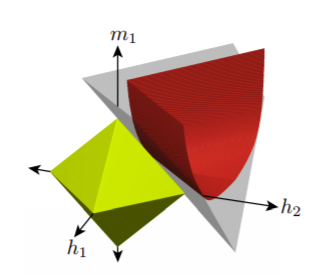
We consider the bilinear inverse problem of recovering two vectors,??and?, from their entrywise product. We consider the case where??and??have known signs and are sparse with respect to known dictionaries of size??and?, respectively. Here,??and??may be larger than, smaller than, or equal to?. We introduce?-BranchHull, which is a convex program posed in the natural parameter space and […]

Read More

Compressive Multiplexing of Correlated Signals

  • February 1, 2022
  • Comments off

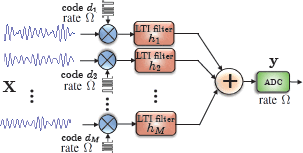
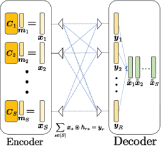
We propose two compressive multiplexers for the efficient sampling of ensembles of correlated signals. We show that we can acquire correlated ensembles, taking advantage of their (a priori-unknown) correlation structure, at a sub-Nyquist rate using simple modulation and filtering architectures. We recast the reconstruction of the ensemble as a low-rank matrix recovery problem from generalized […]

Read More

Compressive sampling of correlated signals

  • February 1, 2022
  • Comments off

The recently developed theory of Compressive sensing (CS) has shown that sparse signals can be reconstructed from a much smaller number of measurements than their bandwidth suggests. In this paper we present a sampling scheme to acquire ensembles of correlated signals at a sub-Nyquist rate. The sampling architecture uses simple analog building blocks including analog […]

Read More

Invertible generative models for inverse problems: mitigating representation error and dataset bias

  • February 1, 2022
  • Comments off

Trained generative models have shown remark-able performance as priors for inverse problems in imaging  for example, Generative Adversarial Network priors permit recovery of test images from 5-10x fewer measurements than sparsity priors. Unfortunately, these models may be unable to represent any particular image because of architectural choices, mode collapse, and bias in the training […]

Read More

A convex approach to blind deconvolution with diverse inputs

  • February 1, 2022
  • Comments off

This note considers the problem of blind identification of a linear, time-invariant (LTI) system when the input signals are unknown, but belong to sufficiently diverse, known subspaces. This problem can be recast as the recovery of a rank-1 matrix, and is effectively relaxed using a semidefinite program (SDP). We show that exact recovery of both […]

Read More

Leveraging Diversity and Sparsity in Blind Deconvolution

  • January 17, 2022
  • Comments off

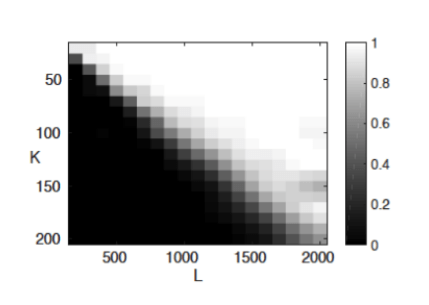
This paper considers recovering L-dimensional vectors w, and x 1 , x 2 , ? , x N from their circular convolutions y_{n} = w * x_{n} , n = 1, 2, 3, ? , N. The vector wis assumed to be S-sparse in a known basis that is spread out in the Fourier domain, […]

Read More

A Convex Approach to Blind MIMO Communications

  • January 14, 2022
  • Comments off

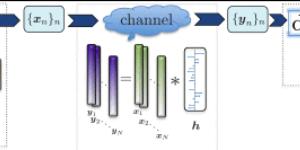
This letter considers the blind separation of convolutive mixtures in a multi-in-multi-out (MIMO) communication system. Multiple source signals are transmitted simultaneously over a shared communication medium (modeled as linear convolutive channels) to multiple receivers. We recast the joint recovery of the source signals, and the channel impulse responses as a block-rank-one matrix recovery problem, which […]

Read More

Loan Risk Prediction/Credit Worthiness

  • January 14, 2022
  • Comments off

Financial institutions provide services such as loans and lease. If a consumer defaults on a loan and fails to pay back the loan amount, financial institution suffers a loss. Hence, it is pivotal for financial institutions to assess the risk of non-payment at the time of application. Utilizing state of the art techniques, like wide […]

Read More

Up-selling/Product Recommendation

  • January 14, 2022
  • Comments off

At the time of purchase of a financial product, there are often a large number of financial products to choose from with subtle differences. Customers often have insufficient knowledge and often end up making a sub-optimal purchase. A model developed by CACTuS ingests initial choice of financial product by the customer and lists closely related […]

Read More