
Blind Deconvolution Using Modulated Inputs
- Post by: admin
- February 2, 2022
- Comments off
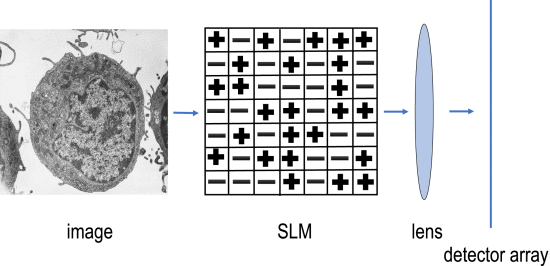
This paper considers the blind deconvolution of multiple modulated signals/filters, and an arbitrary filter/signal. Multiple inputs?![s_1 , s_2 , ... ,s_N =: [s_n]](https://www.qult.ai/wp-content/ql-cache/quicklatex.com-035503b845c7176a6421a3cc9e7c9c4d_l3.svg "Rendered by QuickLaTeX.com") ?are modulated (pointwise multiplied) with random sign sequences?
?are modulated (pointwise multiplied) with random sign sequences?![r_1 , r_2 , ... ,r_N =: [r_n]](https://www.qult.ai/wp-content/ql-cache/quicklatex.com-0adcdff43d37255266488b96ceeb59e1_l3.svg "Rendered by QuickLaTeX.com") , respectively, and the resultant inputs?
, respectively, and the resultant inputs?![(s_n \odot r_n ) \in \mathbb{C}^Q , n \in [N]](https://www.qult.ai/wp-content/ql-cache/quicklatex.com-5644ca450999d6ea2df1a5a0ee15eef4_l3.svg "Rendered by QuickLaTeX.com") ?are convolved against an arbitrary input?
?are convolved against an arbitrary input? ?to yield the measurements?
![y_n = (s_n \odot r_n ) \circledast h, n \in [N] := 1, 2, ... ,N](https://www.qult.ai/wp-content/ql-cache/quicklatex.com-3ffefc8816ff33b4563ebc742ee486a1_l3.svg "Rendered by QuickLaTeX.com") , where?
, where? ?and?
?and? ?denote pointwise multiplication, and circular convolution. Given?
![[y_n]](https://www.qult.ai/wp-content/ql-cache/quicklatex.com-2d55a2db363df18bf17427d0149a985a_l3.svg "Rendered by QuickLaTeX.com") , we want to recover the unknowns?
, we want to recover the unknowns?![[s_n]](https://www.qult.ai/wp-content/ql-cache/quicklatex.com-d0043bf61edd4f2f60ab827cf1536d31_l3.svg "Rendered by QuickLaTeX.com") ?and?
?and? . We make a structural assumption that unknowns??are members of a known K-dimensional (not necessarily random) subspace, and prove that the unknowns can be recovered from sufficiently many observations using a regularized gradient descent algorithm whenever the modulated inputs?
 ?are long enough, i.e,?
 ?(to within logarithmic factors, and signal dispersion/coherence parameters). Under the bilinear model, this is the first result on multichannel?
 ?blind deconvolution with provable recovery guarantees under near optimal (in the?
 ?case) sample complexity estimates, and comparatively lenient structural assumptions on the convolved inputs. A neat conclusion of this result is that modulation of a bandlimited signal protects it against an unknown convolutive distortion. We discuss the applications of this result in passive imaging, wireless communication in unknown environment, and image deblurring. A thorough numerical investigation of the theoretical results is also presented using phase transitions, image deblurring experiments, and noise stability plots.
