Archives

Compressive Multiplexing of Correlated Signals

  • February 1, 2022
  • Comments off

We propose two compressive multiplexers for the efficient sampling of ensembles of correlated signals. We show that we can acquire correlated ensembles, taking advantage of their (a priori-unknown) correlation structure, at a sub-Nyquist rate using simple modulation and filtering architectures. We recast the reconstruction of the ensemble as a low-rank matrix recovery problem from generalized […]

Read More
Compressive sampling of correlated signals

  • February 1, 2022
  • Comments off

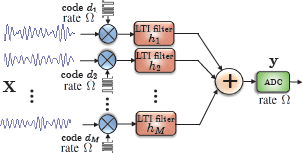
The recently developed theory of Compressive sensing (CS) has shown that sparse signals can be reconstructed from a much smaller number of measurements than their bandwidth suggests. In this paper we present a sampling scheme to acquire ensembles of correlated signals at a sub-Nyquist rate. The sampling architecture uses simple analog building blocks including analog […]

Read More

Invertible generative models for inverse problems: mitigating representation error and dataset bias

  • February 1, 2022
  • Comments off

Trained generative models have shown remark-able performance as priors for inverse problems in imaging  for example, Generative Adversarial Network priors permit recovery of test images from 5-10x fewer measurements than sparsity priors. Unfortunately, these models may be unable to represent any particular image because of architectural choices, mode collapse, and bias in the training […]

Read More

A convex approach to blind deconvolution with diverse inputs

  • February 1, 2022
  • Comments off

This note considers the problem of blind identification of a linear, time-invariant (LTI) system when the input signals are unknown, but belong to sufficiently diverse, known subspaces. This problem can be recast as the recovery of a rank-1 matrix, and is effectively relaxed using a semidefinite program (SDP). We show that exact recovery of both […]

Read More

Leveraging Diversity and Sparsity in Blind Deconvolution

  • January 17, 2022
  • Comments off

This paper considers recovering L-dimensional vectors w, and x 1 , x 2 , ? , x N from their circular convolutions y_{n} = w * x_{n} , n = 1, 2, 3, ? , N. The vector wis assumed to be S-sparse in a known basis that is spread out in the Fourier domain, […]

Read More

A Convex Approach to Blind MIMO Communications

  • January 14, 2022
  • Comments off

This letter considers the blind separation of convolutive mixtures in a multi-in-multi-out (MIMO) communication system. Multiple source signals are transmitted simultaneously over a shared communication medium (modeled as linear convolutive channels) to multiple receivers. We recast the joint recovery of the source signals, and the channel impulse responses as a block-rank-one matrix recovery problem, which […]

Read More

Blind Deconvolution using Convex Programming

  • December 23, 2021
  • Comments off

Blind deconvolution refers to recovering signals by observing only their convolution. Blind deconvolution is a fundamental problem in signal processing, wireless communication, and systems theory. This problem arises in the context of blind channel estimation in wireless communications, passive imaging: for example, to estimate earth layer prole for oil exploration, seismic interferometry, radar imaging, and many other applications&

Read More